Thursday, November 13, 2014

Spencer's Impact

Lees Ferry (no apostrophe according to the National Park Service) is perhaps most well known these days as the launch point for Grand Canyon river trips. Trips of all sizes launch from here. This group was planning to do 225 miles to Diamond Creek in 7 days, leveraging the High Flow that started Tuesday morning.

This group was going to do the same 225 miles in 20 days. (If you can get a permit, why rush it?)

They figured they had enough fuel to last them for the whole trip, and were in the process of unloading the cases into large dry bags as I watched in wonder. Apparently they’d never heard of gray tape.

But the history of Lees Ferry goes way back. In mid 1800’s Lee was the first ferryman living here, providing ferry services across the river for the Mormon pioneers that settled central Arizona.

It was a tough life, and the remains of the Fort at the ferry crossing still exists about ¾ mile up the river from the current boat launch. The remains of the road can be seen on the far side of the river angling up from left to right in this photo.

Other, larger, buildings were built later to serve as office and trading post.

But the other part of history around the turn of the last century was a relatively large scale attempt at gold mining by Charles Spencer. The mining was not successful, but he did leave a lot of rust behind. The most obvious piece is the remains of one of the steam boilers that powered his mining equipment.

Up the river a little way, almost buried and hiding behind some bushes, are the remains of a second steam boiler.

But what I really wanted to see was the status of the remains of the Charles H. Spencer, a steam powered paddle wheeler that was built in 1912 to haul coal from Warm Springs (28 miles up river) to the mine site at Lees Ferry.

It was abandoned 100 years ago. Not much left now. The boiler is obvious, but the bits of ribs still sticking out of the water and some planking is not as obvious at first glance. Something tells me the original investors weren’t too happy.


But none of that ruins the view!

Tuesday, November 11, 2014

They Dammed It

By the time I got the last post done and drove over to the Carl Hayden Visitor Center, I was too late for the 9 a.m. tour, but that was alright.

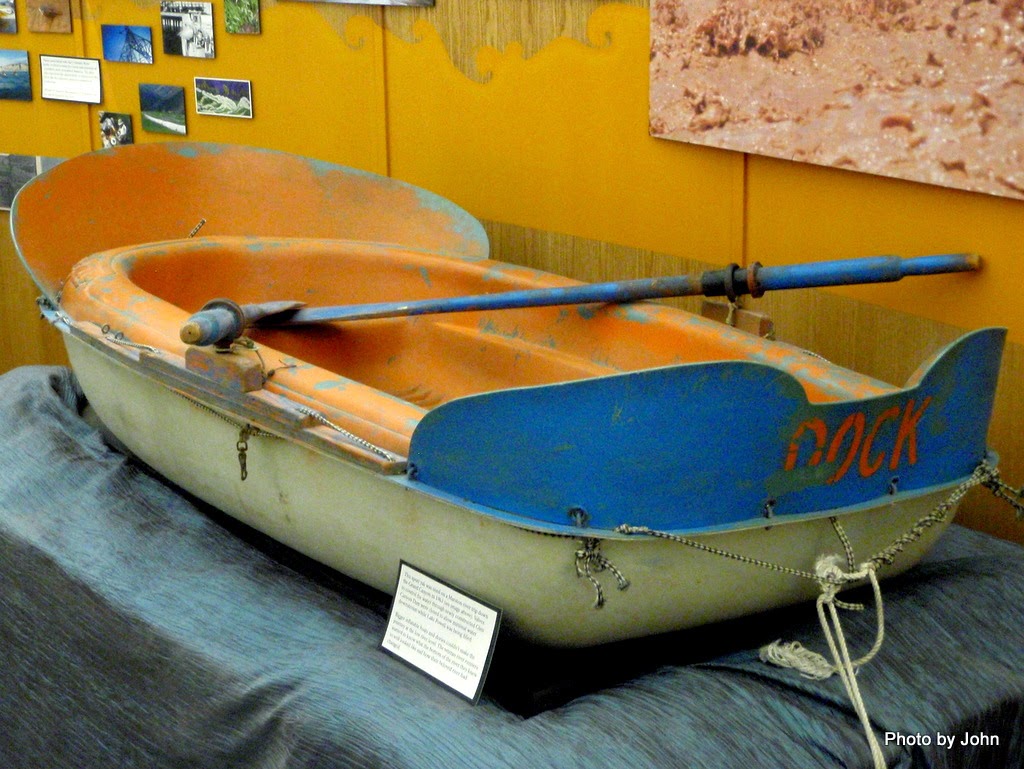
I was surprised, but shouldn’t have been, to see that they had a couple historic boats on display. The Sportyak, a small plastic rowboat (not sure why they infer a connection to kayaks), was rowed by Dock Marston in one (or more??) trips through the Grand Canyon. Looks like a bathtub, and I suspect it rowed like one. It would be a full time job bailing in white water. The most well-known photo of him rowing it in the canyon showed it without the additional bow and stern deflectors.

The other boat was one of the Galloway type that were used by the USGS during their investigation of potential dam sites on the Green and Colorado rivers. It was 18 feet long and weighed 800 pounds, empty!

The volunteer tour guide had worked at the dam for most of his career as an electrical engineer and was very proud of the dam, the operation, and the economic benefits. I was pleased to see that the displays at least recognized that there are serious questions about the dam, which buried over 100 miles of beauty and significantly increases evaporation loses from the Colorado river.

There was a lot of other information about the large and wonderful reservoir. No mention that it hasn’t been anywhere near full for over 15 years.

The dam tour itself was inexpensive, and worth about as much. There were only five of us on this particular tour.

We did get as far as the viewing gallery for the powerhouse. Four of the generators were turning and one was in the process of being rebuilt. The guide says that when they run the High Flow experiment they won’t be able to use all of the water for generation and will be using the bypass tunnels.

Perhaps the best part of the tour was getting a view of the bridge from a different angle.

I was going to stop at the Powell Museum in downtown Page, but in spite of being the site for tourist information, tehy had no parking for anything over 20 feet long so I headed out of town.

It was a very nice 90 mile drive to get to Lees Ferry, about 12 miles as the raven flies, from Page.


The campground was less than half full, even on a Saturday. $6 per night with the Senior pass. No hookups or showers, but there are flush toilets in the bathroom, drinking water is available, and a dump site is nearby. As you can see, some of the sites aren’t level, but it was oriented the right direction!

This post made possible by the free wireless at Mickey D's in Kanab, UT.

Saturday, November 8, 2014

Late Start

By the time I topped off the gas in the truck and made one last stop at the grocery store for carrots, it was after 2 p.m. before I started to leave town, and well after 3 p.m. before Squeak and I got clear of the Phoenix metro area.

As we headed towards Gray Mountain, the last glimmer of sun was disappearing in the mirror. I’d toyed with boondocking west of Sunset crater, but decided to keep going. I’m generally a fan of early departures and early arrivals. This was going to be different! My plan was to head to Lees Ferry, but I really didn’t need to be there until Sunday afternoon, so I headed to Page, Arizona instead.

Page is only about 12 miles from Lees Ferry, but because of terrain and a major landslide that took out a chunk of Highway 89, it’s 90 miles by road. I don’t think I’ve been to Page since I did a solo paddle of a major portion of the reservoir in March, 2003. The lake is still 95 feet below "full pool" eleven years later.

Page, like Boulder City, Nevada, is a town that didn’t exist before the neighboring dam was built. Intended to house construction workers and supporting cast, it’s now the home to many tourist oriented businesses that depend on the draw of Lake Powell, an attraction that has materially decreased since the lake hasn’t been full in over ten years. There are acres of houseboats parked all over town.

As I approached town, the first show of lights was the Navajo Generating Station, yet another ecological fiasco. A coal burning plant, it creates the air pollution that blankets the Grand Canyon and surrounding area most days. I tried to get a night picture, but the good camera isn’t back from warranty repair yet, and the old Olympus Stylus doesn’t’ hand low light so I went back in the morning.


Home for the night was the world’s largest parking lot operator. This was posted thanks to free wireless at the Mickey D across the street.

I'm hoping to do a dam tour today before heading for the Vermilion Cliffs and Lees Ferry.