Showing posts with label Mother Lode. Show all posts

Friday, April 19, 2013

Empire Mine 4/19/2013

We left Jackson, California this morning in search of some Verizon connectivity so that we could post pictures from the last couple days. Our plan was to drive through Sutter Creek, Amador City, Placerville, and Coloma on our way to a County Park east of Marysville.

Finding some connectivity just south of Placerville, we added three posts from the last couple days and in short order had suggestions about a mine in Grass Valley. We'd planned to spend time at Coloma, home of the Marshall Gold Discovery State Historic Park, but they haven't figured out parking for RVs over 20 feet long so we waved and kept moving towards plan B.

The Empire Mine State Historic Park was wonderful. Again, not friendly to larger RVs, but we fit since the parking lot was near empty and we could take two end-to-end spaces. Entrance fee was $7 per person and pets on leashes were welcome.

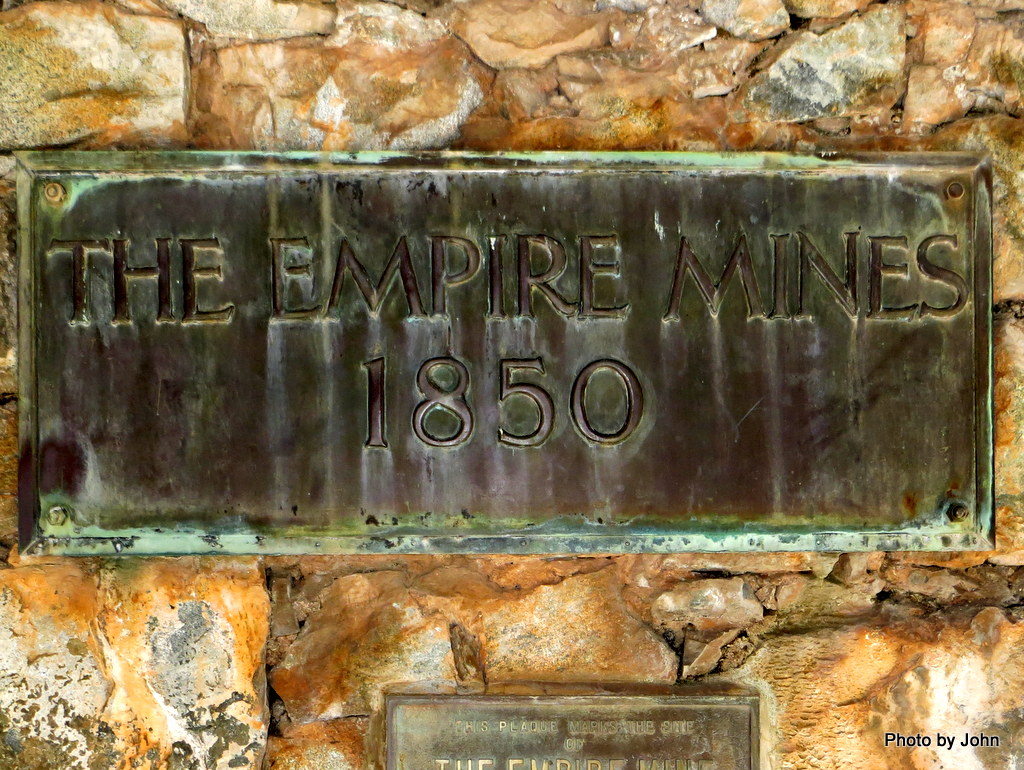
This is the first hard rock mine that we've visited. It operated for about 100 years from approximately 1850 to around 1950. Many of the buildings, including the office, used a combination of rough rock walls with clay bricks around the doors and windows. Clay bricks also capped the rock walls.

We were very fortunate to have a grandson of one of the original Cornishmen who worked the mine as our docent. He even told us which shop in Grass Valley had the best pasty - although none were as good as his grandmother's!

With the exception of the 10 stamp mill used as a display, the mill was gone except for the footings. For this mine alone, they had an 80 stamp mill that could be heard for three miles. Initially it was powered by steam until all the timber was gone, then a Pelton wheel, and eventually electricity.

I found it amazing that they would allow you to descend a little ways into the main shaft. Some of the mine buildings as well as the shoring at the head of the shaft used rails pulled up after the San Francisco earthquake. The picture doesn't show, but this shaft slopes down at about 40 percent.

Most of the support buildings were corrugated iron. Out in the yard were rows of winches and other equipment used in the mine.

I wanted a picture of the wavy old glass. Pretty nice reflection, too.

The mine owners built an English manor style "cottage" (their words, not mine) on the mine property using the same waste rock & clay brick materials. Cost was $25K for the house in 1897 plus $10K for the landscaping.

Loved the arches and the leaded windows.

Today was another up and down day including one section of narrow, winding, 13 percent descent. I was thankful for the ScanGauge and extra transmission cooler!

We're settled in for the evening and enjoyed the long hot showers. We'll dump in the morning before getting in another small dose of freeway miles. Five bars of Verizon 4G with the antenna & amplifier.

Looking for Frogs - 4/18/2013


We were going to start the day at the Tuolumne County Historical Museum but parking near the museum and then the 9am traffic put a quick end to a longer visit in Sonora. All we have is a picture of Sonora in our rear view mirror.

Columbia State Historic Park could have been an all-day affair, although I'm glad we were early in the season and in the middle of the week. Many of the original buildings now include period appropriate businesses operating as concessionaires. The bakery had wonderful cinnamon rolls – just saying…

The fir floor boards to the left of the bowling alley were at least 18 inches wide.

As was true of many of these towns, the successful businesses built with brick and used iron shutters to withstand the fires that seemed to sweep through town on a regular basis.

One hotel featured fancy brickwork and iron balcony railing

while the other featured an ornate lobby as seen through a window.

Throughout town, even most of the hardware

and nails appear original.

The curves and grades were for the most part kinder and gentler than the previous day. We even had this opportunity to take a picture!

As we entered Calaveras County, we started looking for Mark Twain's frogs

and found them in Murphys, another town dating to the gold rush

where many of the original buildings were built of rough stone. This town was full of wine tasting emporiums representing the local wineries.

A number of the buildings in Mokelumne Hill were different yet, built by Italian stonemasons using local cut limestone.

I especially appreciated the keystone work forming the lintels over most windows and doors.

Home for the night was Jackson – a place that Verizon apparently has not yet discovered. The folks from Bentonville were our hosts.

Round and Round - 4/17/2013


In Jamestown, California, the State has a very unique park.  The Railtown 1897 State Historic Park is owned and operated as a State Park and includes the operating Sierra Railroad.

The park includes the original maintenance buildings including the roundhouse and turntable as well as original rolling stock.

Engine #3 is a Rodgers 4-6-0 that came here when the railroad was built from the bankrupt Arizona & Prescott Railway. It is maintained and operated by a large cadre of volunteers and has been featured in many films and TV shows over the past 80+ years.

Engine #2 is a 3 truck Shay, that originally served on the Feather River Railway. There were over 20 Shay engines operating in Tuolumne County during the peak of the lumber era. This one was also used during the construction of the Hetch Hetchy project and now operates occasionally on the home line.

This rail truck is also original to the line, used to support construction of the Hetch Hetchy line. Based on a White truck chassis, it includes its own jack and frame so that it can be jacked up and spun around for the return trip from the end of the line.

The machine shop tools are still used for maintenance of the rolling stock.

All of the machine shop and wood shop is belt driven, although it was converted to electric power from the original Pelton wheel in 1912. Still needs a grease monkey to keep all the bearings greased!

The wood shop hasn’t been used in recent years but they're hoping to get permission to build a new, wooden passenger car since they’re lighter than the steel cars.

It’s the end of our time at Railtown, but was well worth a visit. Entrance is $5 per person and they’re pet friendly! If you go, do the docent led tour which is included in the entrance fee. The tour will give you access to the roundhouse.

Mother Lode Country - 4/17/2013


After bidding Wallyworld adieu this morning, we finished up the last of the straight road for a while and headed back to the scenic roads on our way through towns like Oakhurst, Mariposa, Coulterville, Chinese Camp, and Jamestown. First stop was at the wonderful Mariposa County History Center in Mariposa. They've collected good examples of mining equipment including this Knight water wheel donated by the Schroeder family. Who knew?

Much of their collection is outside and can be freely viewed, including this operating 5 stamp mill used for crushing quartz to release any gold.

The interior of the museum is worth the $4 entrance fee. It is well organized and nicely displayed, featuring daily living from gold rush days. They displayed everything from a large, ornate walnut table from a [the first?] Wells Fargo bank to a large potbellied stove from the Court House to a ball & chain from the sheriff.

We have no pictures of the twisted (both vertically and horizontally) road – too busy driving. Suffice it to say if you’re uncomfortable with narrow, steep, mountain roads lacking guard rails, this might not be your trip.

Hotel Jeffrey in Coulterville was established in 1851, like so many businesses in the area.

The General Store looked like it was once a garage. It wasn't open.

Lots of oak trees on rolling hills, occasional vineyards, and every now and then a logging truck would pass us going the other way.

Chinese Camp has a deserted one block downtown, surrounded by homes of more recent vintage.

Just down the road we found a pull-off on the border of BLM's Red Hills area that became our parking spot for the night. Turns out the road is a short-cut for locals going to work so it saw some traffic late in the afternoon and again early in the morning. No cell connectivity here.